


Puppy Journey Begins
The first eight weeks of a puppy’s life are filled with extraordinary growth.
Long before a puppy meets their new family, they are learning about people, other dogs, sounds, surfaces, handling, frustration, recovery, play, rest, and the world around them.
At Tethered by Grace Inc., we believe responsible breeding is about more than producing healthy puppies. It also means giving those puppies a thoughtful, developmentally appropriate beginning.
The first eight weeks don't determine everything—but they matter.
The Foundation For A Lifetime
Weeks 0–2: A World of Warmth, Scent & Touch
Newborn puppies enter the world highly dependent on their mother and breeder.
Their eyes and ears are still developing, and much of their early experience revolves around warmth, scent, touch, nursing, sleeping, and physical contact.
During this stage, breeders should focus primarily on health, safety, careful observation, and appropriate handling.
Important responsibilities may include:
-
Monitoring nursing
-
Tracking weights and growth
-
Keeping puppies warm and comfortable
-
Maintaining a clean environment
-
Watching the mother closely
-
Identifying puppies that may need additional support
-
Providing gentle, appropriate handling
-
Seeking veterinary care when concerns arise
At this age, more stimulation isn't automatically better.
Experiences should match the puppy's developmental stage.
Weeks 2–3: The World Begins to Open
As puppies' eyes and ears begin functioning, their world changes quickly.
They begin noticing littermates, movement, light, sounds, and people in new ways.
Mobility increases.
Interaction becomes more intentional.
This is a period of rapid neurological and physical development.
Responsible breeders can begin gently expanding the puppies' environment while continuing to protect plenty of time for sleep, nursing, and rest.
Weeks 3–5: Curiosity Takes Off
Now puppies begin exploring.
They play with littermates, investigate objects, interact more with people, develop coordination, and begin practicing communication through play.
This is an important time for carefully planned experiences.
Puppies may begin encountering:
-
Different safe surfaces
-
Household sounds
-
Toys and objects
-
Gentle handling
-
New smells
-
Age-appropriate obstacles
-
Short periods of individual attention
-
Different people
-
Grooming-related experiences
-
Early introductions to crates or resting areas
The goal isn't to overwhelm puppies with as many experiences as possible.
The goal is to create positive, manageable experiences that help puppies learn how to explore and recover.
Weeks 5–8: Preparing for a Bigger World
As puppies become more coordinated and independent, their learning opportunities expand.
This is a valuable time for responsible breeders to continue exposing puppies to carefully selected experiences while observing each puppy as an individual.
Activities may include:
-
Indoor and outdoor exploration when safe
-
Different textures and surfaces
-
Household activity
-
Appropriate novel sounds
-
Car rides
-
Individual handling
-
Grooming and nail care
-
Short separations from littermates
-
Beginning crate familiarity
-
Appropriate interactions with trusted people
-
Problem-solving activities
-
Age-appropriate enrichment
-
Foundations for house-training routines
Puppies should still have abundant opportunities to sleep, rest, play naturally, and interact with their mother and littermates.
Development doesn't need to be rushed.
Socialization Is More Than Meeting People
Socialization is often misunderstood as simply introducing a puppy to lots of people and dogs.
It's much broader than that.
Good early socialization can help puppies learn that the world contains different:
-
People
-
Sounds
-
Surfaces
-
Objects
-
Environments
-
Movements
-
Handling experiences
-
Smells
-
Everyday activities
But exposure alone isn't enough.
The quality of the experience matters.
A frightened puppy being forced through an overwhelming situation isn't experiencing good socialization.
Responsible socialization pays attention to the puppy's comfort, body language, confidence, and ability to recover.

Key Tips
Health & Veterinary Care Matter Too
Developmental experiences should occur alongside appropriate medical care.
Depending on the puppies' age and veterinary recommendations, responsible care may include:
-
Monitoring growth
-
Physical examinations
-
Parasite control
-
Vaccination planning
-
Identification of congenital or developmental concerns
-
Nutrition guidance
-
Individual health records
-
Veterinary treatment when necessary
Responsible breeders should provide families with clear information about the veterinary care each puppy has received.
Every Puppy Is an Individual
Even puppies raised in the same litter can be very different.
One may be confident and adventurous.
Another may be thoughtful and observant.
One may seek constant interaction.
Another may enjoy more independence.
These differences matter.
Rather than deciding which puppy is "best," responsible breeders can use their observations to help determine which puppy may be the best fit for a particular home.
Matching Puppies With Families
Thoughtful puppy placement is about more than letting someone choose based on color, markings, or which puppy runs over first.
When possible, breeders can consider:
-
Temperament
-
Energy level
-
Confidence
-
Recovery
-
Sociability
-
Independence
-
Working drive
-
Sensitivity
-
Family lifestyle
-
Experience level
-
Children or other pets
-
Intended activities
-
Expectations for adult life
No breeder can guarantee exactly how a puppy will develop.
But weeks of daily observation can provide valuable information that a family cannot gather during a short visit.

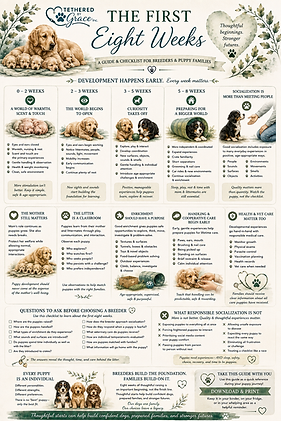
Take Tethered Tips With You
We've created a First Eight Weeks Guide & Checklist to help breeders and puppy families understand developmental stages, purposeful socialization, enrichment, cooperative care, veterinary care, and the questions families can ask before choosing a puppy.
Use it when researching breeders, preparing for a litter, or learning what thoughtful early puppy development can look like.
Knowledge creates better questions. Better questions lead to better choices. Explore our Library for even more tips!
What We Want You to Remember
The first eight weeks aren't about creating a "perfect puppy."
They're about creating a thoughtful beginning.
Protect their health.
Give them safe experiences.
Watch the individual puppy.
Build confidence without forcing it.
Allow plenty of rest.
Prepare them gently for the world ahead.
Those first weeks are only the beginning.
But beginnings matter.
Thoughtful starts can help build confident dogs, prepared families, and stronger futures.
Our dogs are family.
Our choices leave a legacy.